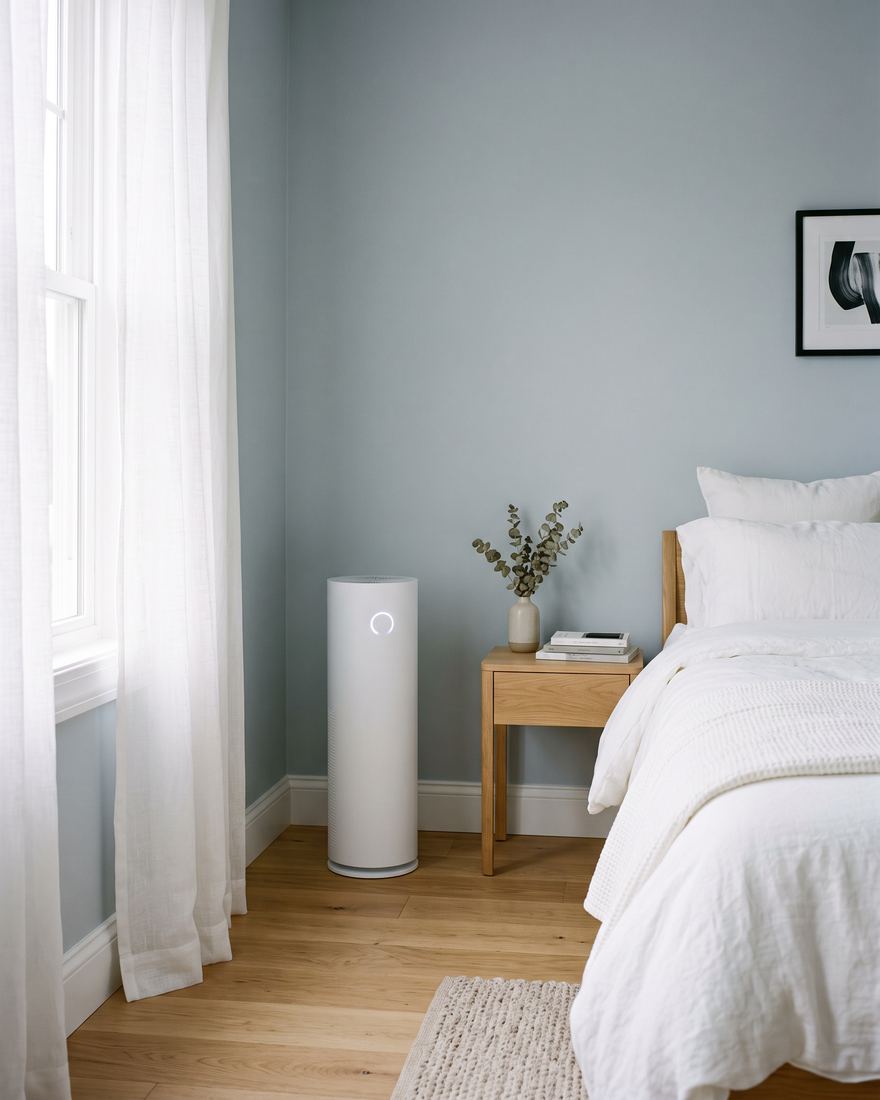
Air purifiers work by pulling room air through a filter. For allergies, the filter that matters is True HEPA, which by the US standard captures at least 99.97% of particles 0.3 microns in size. Pollen, pet dander and mold spores are generally larger than that.
Purifiers help most with allergens that float: pollen, pet dander and mold spores. Dust mite allergen is heavier and settles fast, so for mites, bedding and cleaning matter more.
How to choose
Measure the room
Multiply length by width for square feet. Buy a purifier rated for that size or larger, so it can run on a quiet setting.
Check the CADR
Clean Air Delivery Rate tells you how fast it cleans. A common rule of thumb is a smoke CADR of at least two-thirds of your room’s square footage.
Confirm True HEPA
Skip anything labeled "HEPA-type" or "HEPA-like." Those aren’t held to the same standard.
Avoid ozone
Ozone generators and some ionizers can irritate lungs. Look for CARB certification, which limits ozone output.
Price out filters
Replacement filters are the real long-term cost. Check the price and how often they need changing.
Listen to the noise rating
If it’s too loud to sleep with, you won’t run it. Look for a decibel rating on the low setting.
What size purifier do you need?
Enter your room in feet. We’ll estimate the clean air delivery rate (CADR) to look for.
All measurements in feet.
Look for a smoke CADR of at least
112
Estimates only. Bigger is fine: a larger purifier on a low setting is quieter than a small one on high.
Shop purifiers for 200 sq ftWhat to shop for
We may earn a commission when you buy through these links, at no extra cost to you. How we choose products
Bedroom True HEPA purifier$$
Cleans the air in the room where you spend 8 hours a night.
Look for: True HEPA, CARB certified, sleep mode under ~30 dB
Large-room purifier with air-quality sensor$$$
Auto mode ramps up when you cook, vacuum or open the door.
Look for: CADR for 400+ sq ft, PM2.5 sensor, auto mode
Pet-focused purifier$$
Extra pre-filter catches hair before it clogs the HEPA layer.
Look for: Washable pre-filter, True HEPA, activated carbon for odor
Desktop personal purifier$
A clean-air bubble at your desk or nightstand.
Look for: True HEPA, USB or low-power, quiet
Car air purifier$
Helps during pollen season commutes.
Look for: HEPA filter, fits a cup holder or headrest
Smart purifier with app control$$$
Turn it on before you get home, track air quality over time.
Look for: True HEPA, app with filter-life alerts
MERV 13 furnace filters$
Upgrades the whole house every time the HVAC runs.
Look for: Your exact filter size; check what your system supports
Replacement HEPA filters$
An old filter does far less. Keep a spare on hand.
Look for: Genuine or certified-compatible filter for your exact model
Indoor air-quality monitor$$
See particle levels, humidity and when your purifier is working.
Look for: PM2.5, humidity and temperature readings
Window screen pollen filter$
Lets a breeze in while catching some pollen.
Look for: Fine mesh that fits your window size
Vent filter sheets$
Extra filtration on supply vents in the bedroom.
Look for: Cut-to-fit, electrostatic
Common questions
Where should I put my air purifier?
In the room where you spend the most time, usually the bedroom. Keep it a foot or two from walls and furniture so air can flow.
Should I run my purifier all the time?
For allergies, yes. Most purifiers are designed to run continuously, and auto mode can keep noise and energy down.
Do air purifiers help with dust?
They catch dust that’s in the air but won’t clean dust that has already settled. Pair a purifier with regular HEPA vacuuming.